How to Grow Healthy Nails: Simple Habits for Stronger Nails
Affiliate disclosure: This article contains affiliate links. If you buy through them, we may earn a small commission at no extra cost to you. As an Amazon Associate I earn from qualifying purchases. Links go to Amazon search results for the product types we mention, not to specific products we have tested.
Not medical advice. This article shares general information only. It is not a substitute for advice from a doctor or dermatologist. Patch-test new products and talk to a professional about any skin, health or fitness concerns.
Healthy nails come down to everyday habits more than any single product. Two K-beauty habits are relevant here: hand cream as an everyday essential, kept by the sink and in your bag, and semi-cured gel nail strips, which look like a salon manicure but need careful removal.
This guide covers how to grow healthy nails with dermatologist-backed basics, plus the K-beauty habits worth borrowing and the ones to approach carefully.
Disclaimer: This article is general information, not medical advice. If your nails change color or shape, swell, hurt, lift from the nail bed or you notice a dark streak, see a dermatologist. If you have diabetes or poor circulation, get any nail problem checked promptly.
How nails grow
Nails grow from the matrix, the area under the skin at the base of the nail. Fingernails grow slowly, so changes in your habits take months to show along the whole nail. That's why consistency matters more than quick fixes. Damage you see today often happened weeks ago.
Daily habits for healthier nails
The American Academy of Dermatology (AAD) recommends a short list of habits. Here's how to build them into your routine.
Keep nails moisturized
The AAD notes that too much water exposure can weaken nails, causing them to split, peel or break, and recommends moisturizing after hand washing. This is where the K-beauty hand-cream habit helps: keep a tube by every sink, at your desk and in your bag, and use it every time you wash your hands. Rub the extra into your nails and cuticles.
- Look for: a rich cream with ingredients like shea butter, glycerin or ceramides.
- At night: a thicker layer, or petroleum jelly on nails and cuticles, under cotton gloves if your hands are very dry.
The face-and-body ceramide creams popular in K-beauty work well on hands too, for example ILLIYOON Ceramide Ato Concentrate Cream from Amorepacific-owned ILLIYOON.
Shop Korean hand creams on Amazon
Use cuticle oil
A drop of cuticle oil massaged into each cuticle and nail keeps the skin around your nails soft and less likely to crack or form hangnails. Do it at night or while you watch TV.
Wear gloves
The AAD recommends wearing gloves when cleaning or washing dishes. Cleaning products and long soaks in water are hard on nails. Wear warm gloves outside in winter, too.
Don't use nails as tools
Opening cans, scraping labels and prying lids can chip, split or lift your nails, according to the AAD. Use a tool instead.
Stop picking and biting
Biting nails or removing cuticles can damage the nail. If you bite, try keeping nails short and filed smooth, using a bitter-tasting nail product or keeping your hands busy.
Keep nails clean and dry
The AAD notes that bacteria and fungi thrive in moist environments. Dry your hands well after washing, including under your nails.
How to file nails correctly
- Cut straight across with sharp nail scissors or clippers, then round the tips slightly, as the AAD recommends.
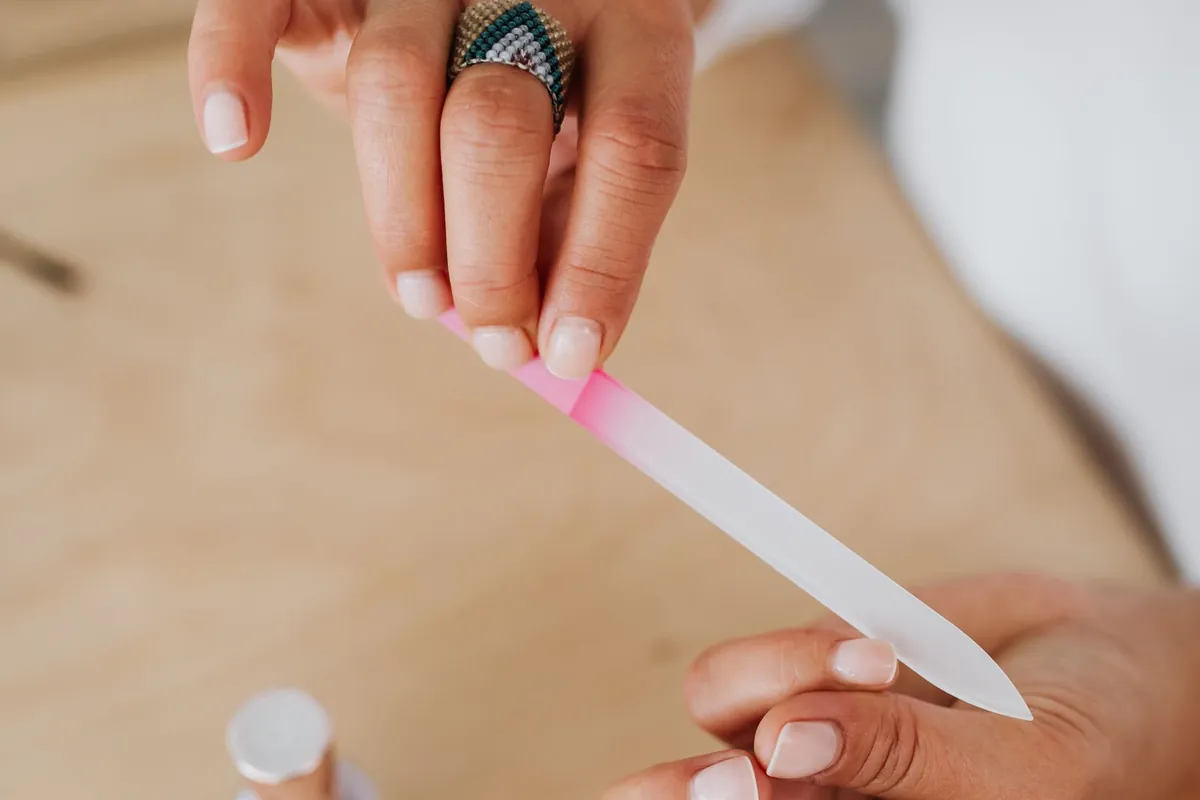
- File with an emery board or a fine glass file to keep edges smooth and free of snags.
- File in one direction rather than sawing back and forth, which can fray the edge.
- File dry nails. Wet nails are softer and more likely to tear.
Shop glass nail files on Amazon
Cuticle care
Your cuticle protects the base of your nail. The AAD advises against removing it. Instead:
- Soften cuticles with cream or oil.
- Gently push them back after a shower if you like, using a soft tool, not a metal pusher.
- Never cut living skin. Trim only loose hangnails with clean nippers.
Polish and removal
Use a base coat
A base coat helps protect nails from staining by colored polish.
Give nails occasional breaks
The AAD suggests taking a polish "holiday" of one to two weeks or longer between gel manicures, and applying a moisturizing product such as petroleum jelly to nails and cuticles several times a day in between.
Remove polish gently
Use remover on a cotton pad pressed onto the nail for a few seconds rather than scrubbing. Moisturize afterward.
Be careful with gel and acrylic removal
The AAD says gel manicures can cause brittleness, peeling and cracking, and advises against picking gel polish off. It recommends soaking only your fingertips in acetone, or wrapping acetone-soaked cotton on each nail with foil, for about 15 minutes. It also suggests applying a broad-spectrum, water-resistant SPF 30+ sunscreen to your hands before a gel manicure, or wearing dark, opaque gloves with the fingertips cut off, because of the UV light used to cure gel. (In the US, sunscreens are FDA-regulated over-the-counter drugs, so look for a US Drug Facts label.)
Korean gel nail strips: what to know
Semi-cured gel nail strips, popularized by Korean brands such as ohora, are stickers made of partly cured gel. You apply them to clean nails, trim the excess and cure them under a UV/LED lamp. They're a convenient at-home alternative to salon gel, but the same nail-health rules apply.
- Don't peel them off. ohora's own removal guide says not to forcibly peel off its strips, because it may damage your natural nails. It recommends sliding a remover-soaked wooden stick under the edge to dissolve the adhesive gradually.
- Protect your hands from UV during curing, as the AAD suggests for gel manicures.
- Take breaks between sets so your nails can recover, and moisturize nails and cuticles in between.
- Stop if your skin reacts. Redness, itching or swelling around the nails after gel products can be a sign of allergy. Remove the product and see a dermatologist.
Winter and frequent hand-washing
Cold, dry air and frequent hand-washing are a tough combination for nails and cuticles. In winter:
- Switch to a richer hand cream and reapply after every wash.
- Wear gloves outdoors, and cotton gloves over a thick layer of cream or petroleum jelly at night if your hands crack.
- Dry hands completely, including between your fingers and under your nails.
- Run a humidifier in your bedroom.
For the rest of your winter routine, see our Korean skincare for dry winter skin guide.
A weekly nail care routine
| When | What |
|---|---|
| After every hand wash | Hand cream, rubbed into nails and cuticles |
| Every night | Cuticle oil or petroleum jelly on nails and cuticles |
| Once a week | Trim straight across, file smooth, push back softened cuticles gently |
| While cleaning | Gloves |
| Between gel or gel-strip sets | A one- to two-week polish break |
What about diet and supplements?
A balanced diet supports overall health, including your nails. Biotin supplements are often marketed for nails, but don't start supplements without talking to your doctor or pharmacist: the FDA has warned that biotin can interfere with some lab tests, so tell your doctor and lab if you take it. Brittle nails can also have medical causes that a doctor should check.
When to see a doctor
The AAD advises seeing a dermatologist if your nails change, swell or cause pain. Also see a doctor for:
- A new dark streak or spot under a nail
- Nails lifting from the nail bed
- Thick, discolored or crumbly nails
- Redness, swelling or pus around a nail
Frequently asked questions
Why do my nails peel?
Frequent wetting and drying, harsh removers and picking off gel are common causes. Moisturizing after every hand wash and wearing gloves usually help. If peeling persists, see a dermatologist.
Are Korean gel nail strips bad for your nails?
Not necessarily, but removal matters. Forcing or peeling strips off can damage the nail surface. Follow the brand's removal directions, protect your hands from UV during curing and take breaks between sets.
Is it bad to wear nail polish all the time?
Regular polish is generally fine, but breaks help, especially after gel. Use a base coat and moisturize your nails and cuticles.
How long does it take to grow out a damaged nail?
Several months for a fingernail, and longer for toenails, because nails grow slowly.
The bottom line
Healthy nails come from small daily habits: hand cream after every wash, cuticle oil at night, gloves for wet work and gentle filing. If you love Korean gel strips, follow the brand's removal steps, protect your hands from UV and give your nails time off between sets.
About the author: This guide was researched and written by the K-Beauty Glow Up Editorial Team using American Academy of Dermatology guidance and brand pages. We haven't tested these products ourselves. For any nail change that worries you, consult your doctor or a dermatologist.
Read next: 15 Budget Beauty Tips to Save Money Without Cutting Corners →