How to Make Foundation Look Natural (Not Cakey)
Affiliate disclosure: This article contains affiliate links. If you buy through them, we may earn a small commission at no extra cost to you. As an Amazon Associate I earn from qualifying purchases. Links go to Amazon search results for the product types we mention, not to specific products we have tested.
Not medical advice. This article shares general information only. It is not a substitute for advice from a doctor or dermatologist. Patch-test new products and talk to a professional about any skin, health or fitness concerns.
Korean base makeup is famous for looking like skin, not makeup. The secret isn't a single miracle foundation. It's a method: well-hydrated skin underneath, very thin layers of coverage, and tapping instead of rubbing. The cushion compact, popularized by Korean brands, is built around exactly that idea.
Here's how to make foundation look natural using that "skin-first" approach, whether you use a Korean cushion or the liquid foundation you already own.
1. Find the right shade
A natural finish starts with a match. Test shades along your jawline, not your hand, in daylight. The right shade disappears into your skin and blends smoothly into your neck.
Undertones
- Cool: pink, red or bluish undertones. Silver jewelry often looks better on you.
- Warm: yellow, golden or peachy undertones. Gold jewelry often suits you.
- Neutral: a mix of both.
Korean shade names usually combine a number and a letter, such as 21C or 23N. The number indicates depth (lower is lighter) and the letter the undertone: C for cool, W for warm and N for neutral. Ranges vary by brand. LANEIGE's international page for its Neo Cushion The Glow, for example, lists seven shades from 13C to 25C, so if you have a deeper skin tone, check the range before you buy and consider a tinted mineral sunscreen or a brand with a wider range instead.
2. Choose the right formula
- Cushion compact: a sponge soaked in liquid foundation inside a compact, applied with a puff. Usually light to medium coverage that's easy to build in thin layers. Dewy and matte versions are common.
- BB or CC cream: sheer, often skincare-like. Good for a "barely there" look.
- Skin tint or tinted sunscreen: the lightest option.
- Liquid foundation: the widest range of shades and finishes.
For a natural look, pick a finish close to your skin: dewy or satin for dry and normal skin, soft-matte for oily skin.
A note on SPF in cushions: many Korean cushions list an SPF, and LANEIGE's Neo Cushion The Glow international page lists SPF 50 PA+++, for example. But you'd need to apply far more foundation than anyone actually wears to get the labeled protection. Wear a broad-spectrum SPF 30+ sunscreen underneath and treat cushion SPF as a bonus.
US sunscreen note: In the US, sunscreens are regulated by the FDA as over-the-counter drugs, and US products may only use the UV filters on the FDA's permitted list. Many filters used in Korean sunscreens are not on that list. In June 2026 the FDA added bemotrizinol, the first new active ingredient added to its sunscreen monograph since the late 1990s (FDA announcement). Korean-market versions may differ from US versions, so check for a US Drug Facts label.
3. Prep your skin the Korean way
Foundation looks cakey mostly because of what's underneath. Dry patches grab pigment, and oily skin breaks it up. K-beauty prep focuses on hydration without heaviness:
- Hydrating toner, pressed in with your hands. Two thin layers if you're dry. See our Korean toner guide by skin type.
- Light moisturizer. Use a gel-cream if you're oily and a cream if you're dry. Let it absorb for a few minutes.
- Sunscreen, then wait a few minutes. Putting foundation on wet sunscreen is a common cause of pilling and patchiness.
- Primer (optional), only where you need it: a blurring primer on pores or a hydrating one on dry cheeks.
If flaky patches are the problem, the fix is moisture, not more foundation. Our Korean skincare for dry winter skin routine helps in cold months.
4. Use less than you think
The Korean approach is thin layers. Start with a small amount on the center of your face, where most people need the most coverage, and blend outward. You usually need much less on your forehead, jaw and around your hairline. Build a second thin layer only where you need it, rather than one thick layer everywhere.
5. Choose your tool
- Cushion puff: press the puff lightly into the cushion once, then tap (don't swipe) onto your skin, starting at the center of your face. Fold the puff to reach around your nose and under your eyes. Some cushions now come with smaller or dual-tip puffs for these areas.
- Damp sponge: bounce it over the skin for a sheer, skin-like finish.
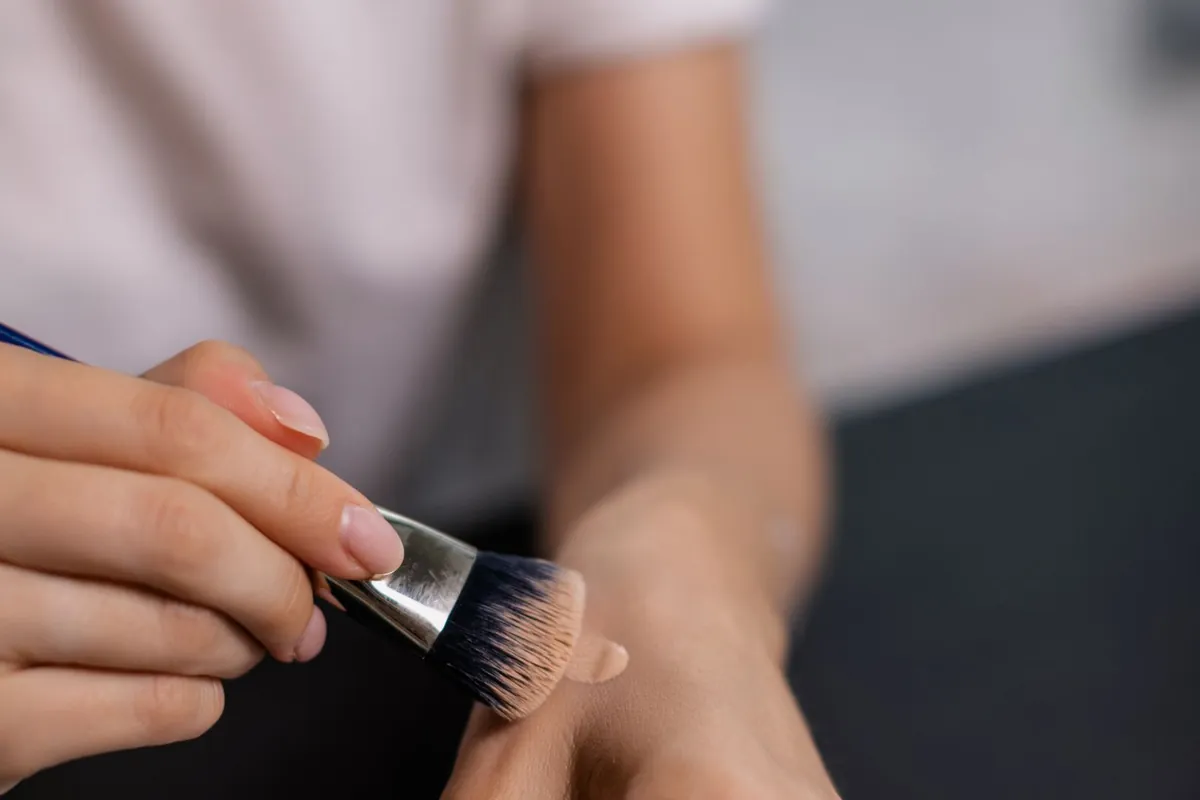
- Brush: a dense, flat-top brush in small circles or stippling motions for more coverage.
- Fingers: warm, quick and natural, especially for skin tints.
Whatever you use, tap and press rather than rub. Rubbing moves product around and leaves streaks.
Shop LANEIGE Neo Cushion on Amazon
Note that LANEIGE's international ingredient list for Neo Cushion The Glow includes fragrance, which matters if your skin is fragrance-sensitive.
Conceal only where you need it
Korean base routines lean on spot concealing instead of heavier foundation. After your thin base layer, dab concealer only on what still shows: redness around the nose, a blemish, or under-eye shadows. Tap the edges with a fingertip or the corner of your puff so only the center of the dot keeps full coverage. Under the eyes, use a tiny amount and a slightly lighter, peachier shade if you have dark circles, then press, don't swipe. Too much concealer under the eyes is one of the quickest routes to creasing, so build slowly.
6. Blend into the neck and hairline
Take any leftover product on your puff or sponge down your jaw and lightly onto your neck. Blend at your hairline and ears so there's no visible edge.
7. Set lightly
Korean base makeup usually keeps some glow. Instead of powdering your whole face:
- Oily skin: lightly press a translucent powder on your T-zone.
- Normal or dry skin: powder only the sides of your nose and under your eyes, if anything.
- Setting spray (optional): a light mist can melt powder into the skin for a more natural finish.
The Korean "glass skin" base vs a matte base
| Dewy "glass skin" base | Soft-matte base | |
|---|---|---|
| Suits | Dry and normal skin | Oily and combination skin |
| Prep | Two toner layers and a cream | One toner layer and a gel-cream |
| Product | Glow cushion or skin tint | Matte cushion or soft-matte liquid |
| Setting | Powder only around the nose | Light powder on the T-zone |
| Touch-ups | A hydrating mist | Blotting papers, then a press of powder |
For the skincare side of glass skin, see our Korean glass skin routine.
Fixes for common problems
- Cakey: too much product or dry skin. Moisturize better, use less and blend with a damp sponge. Mist and press with a clean puff to soften it.
- Separating on the nose: oily skin or rich moisturizer underneath. Use a lighter moisturizer there, blot before touch-ups and set lightly.
- Clinging to dry patches: too little prep. A hydrating toner and cream underneath, and a dewier formula, usually help.
- Looks gray or ashy: wrong shade or undertone, or a white cast from sunscreen. Try a warmer shade or a tinted sunscreen underneath.
- Visible line at the jaw: blend down the neck, or try a different shade.
- Pilling: too many layers, or products that don't mix well. Wait longer between steps and use less of each.
Keep your puff and sponge clean
A dirty cushion puff spreads old makeup and oil back onto your skin and looks patchy. Wash puffs and sponges often, and replace them when they get torn or stiff. Shop replacement cushion puffs on Amazon Our guide to how to clean makeup brushes covers cushion puffs too.
Want the full look? See our natural makeup look for beginners.
Frequently asked questions
Is a cushion foundation better than liquid foundation?
Neither is better; they're different. Cushions are portable and make thin, tapped layers easy, which suits a natural look. Liquids usually come in more shades and finishes. If you can't find your shade in a cushion, use a liquid with a damp sponge for a similar effect.
Should foundation be lighter or darker than my skin?
Neither. It should match your neck and jaw. Use a separate concealer if you want to brighten specific areas.
Do I need primer?
Not always. Good skincare prep often does more than primer. Use it only if you have a specific need, such as large pores or very oily skin.
The bottom line
Natural-looking foundation is mostly about what you do before and while you apply it. Hydrate in thin layers, let sunscreen set, use a separate sunscreen rather than relying on cushion SPF, use less product than you think, tap it on from the center out and keep some glow. That's the Korean "skin-first" base, and it works with any foundation.
About the author: This guide was researched and written by the K-Beauty Glow Up Editorial Team using brand product pages and FDA sunscreen guidance. We haven't tested these products ourselves. If makeup irritates your skin, stop using it and consult a dermatologist.
Read next: How to Clean Makeup Brushes and Sponges (Fast and Easy) →